
If you follow entertainment news, you’ve probably noticed a pattern: months before a blockbuster movie or video game is released, its biggest secrets are already spoiled. Not by a hacked server or a shared screener, but by a toy.
In 2026 alone, toys have exposed major plot points, characters, and other details studios would rather have kept under wraps. Hasbro’s action figures gave Marvel fans an unplanned look into character costumes appearing in Avengers: Doomsday. Weeks later, LEGO added to the spoiler supply, with set drawings some fans worry may give away major action sequences. Another Hasbro figure let slip a major Hulk-related plot beat from Spider-Man: Brand New Day before Marvel had confirmed it on screen.
It’s not just movie tie-ins getting shared too early. McFarlane Toys spoiled Bethesda’s Fallout franchise releases twice this year, first by hinting at a Fallout 3 remaster in the spring, then a Fallout: New Vegas remaster that summer.
And this pattern isn’t new. Toy tie-ins for Godzilla vs. Kong outed kaiju designs back in 2020, and there have been so many plot points leaked via Star Wars action figures that there’s a whole blog post just running down the worst offenders.
None of these leaks come from a traditional security breach. Instead, the images came from the normal, unavoidable flow of a toy’s production. Somewhere along that chain, a single image makes its way to the public, and a studio’s multimillion-dollar marketing plan unravels in a day.
Why the drip of information from toys keeps happening
Toy production is a uniquely leaky pipeline. A single licensed figure might pass through concept designers, a licensor’s legal and brand team, an overseas factory, and dozens of retail buyers, airing details outside the toy company’s own walls. But it also passes through the toy company’s own marketing, e-commerce, and PR teams, too. Every one of those touchpoints, internal or external, is a person with a camera phone or a “publish” button, and often, very little visibility into which details are still confidential.
Studios and licensors have tried the obvious fixes: tighter NDAs, watermark stamps slapped across reference images, and reactive takedown requests once a leak has already gone viral. None of it actually solves the problem. Visible watermarks are cropped or blurred out. NDAs assign blame after the damage is done. And by the time a takedown notice is filed, the images have already been shared across every fan site tracking the franchise.
What’s missing isn’t more paperwork. It’s the ability to know, within minutes, exactly which copy of an image or file leaked, and who it was sent to.
Finding the source of leaks faster
Once the toy genie is out of the bottle, the important thing is to figure out where the leak came from to avoid it happening again.
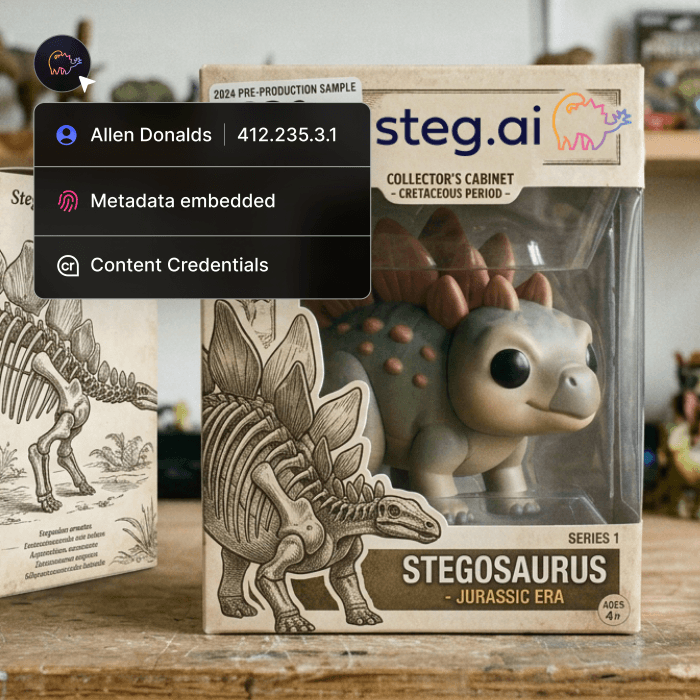
This is where invisible, steganographic watermarking comes in. Instead of stamping a visible logo across a proof image (which just invites cropping), each individual copy of a concept image, factory sample photo, or packaging file gets a unique, imperceptible signature embedded directly into the pixel data. The image looks unchanged to the human eye, but that copy is now traceable back to the exact recipient, business unit, or vendor it was sent to.
When a leak surfaces on social media or a fan forum, that image can be checked against the watermark database in seconds, immediately identifying which link in the supply chain it came from. What used to be a weeks-long forensic investigation becomes a same-day answer.
For IP protection and brand licensing teams, often sitting a step or two below the Chief Information Security Officer (CISO) and managing dozens of active licenses at once, that traceability shifts leak response from a reactive scramble to something closer to a fast, evidence-backed process.
What to look for in a forensic watermarking tool
Traceability only pays off if the tool that provides it actually gets used, and that means finding a tool featuring a couple of practical things:
- It’s built for non-technical teams. The IP protection and brand licensing teams juggling launch calendars are often managing dozens of active licenses at once. And these are brand experts, not engineers, who can manage complex programs. As a result, watermarking should be about as easy as uploading a file. An easy-to-use tool helps teams make watermarking a routine step on every concept image and packaging proof, not a special process that quietly lapses once the person who set it up moves on.
- It’s durable enough to survive how leaks actually spread. By the time an image surfaces, it’s usually been altered several times over. A marker that is only going to work on the original file isn’t much help once that image has been screenshotted and cropped. So a forensic watermark has to remain readable through the kind of distortion that happens on the way to a fan forum or social feed.
Get those two things right, and a watermarking system stops being something that sits unused after launch and becomes a tool the brand team actually relies on, day in, day out.
Putting toy leaks back in the box
Toy leaks aren’t just embarrassing, they’re a measurable cost to the toy company itself. Every high-profile leak invites more scrutiny, because it signals that a company’s supply chain is porous. And that’s the kind of reputation that follows a licensee into the next negotiation.
The actual cost of the leak hits a toy company after the fact. A licensor who’s been burned has less reason to hand over early creative assets on the next project. That often means less lead time before a movie or game’s release, which leaves less time for the toy company’s own design, tooling, and manufacturing process, the kind of work that makes a good product possible.
Invisible watermarking doesn’t stop every leak from happening. But it does something arguably more valuable: it makes every leak solvable, turning an open-ended mystery into a traceable, closable incident, and giving a toy company a real answer the next time a licensor asks what happened.
For a toy company, the real product isn’t just the figure on the shelf, it’s the trust that gets it early access to a licensor’s IP in the first place. That shift from guessing to knowing is what keeps that trust intact, and with it, the lead time needed to build a good product instead of a rushed one.