
Reduce brand risk with watermark-embedded content provenance.
Unauthenticated and AI-manipulated content puts trust, revenue, and compliance at risk. Steg.AI's watermarks provide resilient content provenance and authenticity verification to protect customers, employees, and your brand.
Contact Sales
Misinformation Moves Faster Than Facts
A single piece of false or manipulated content can spread panic in minutes, triggering customer distrust, market volatility, or financial instability.

Prove Provenance
Establish verifiable attribution and chain of custody so customers, employees, and regulators can trust where content came from and how it has been handled.

Detect Manipulation
Identify if and how content was altered so teams can quickly assess impact, prepare a factual response, and counter misinformation with evidence.

Verify Sources
Provide a trusted verification portal where press, customers, and partners can confirm authenticity and see whether content has been manipulated.

Steg.AI + C2PA: Authenticity That Persists
C2PA metadata alone can be stripped, altered, or lost as content moves across platforms. Steg.AI strengthens C2PA by embedding forensic‑grade, invisible watermarks directly into media, ensuring authenticity signals persist even when metadata does not.
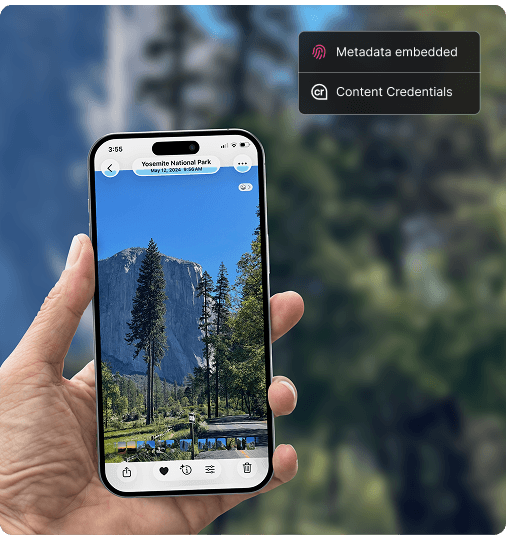
Media Authenticity Across the Content Lifecycle
- 1. Capture:Embed watermarking on device or at the upload or ingest stage
- 2. Edit:Preserve authenticity through common editorial workflows
- 3. Verify:Instantly check authenticity of distributed content using Steg.AI verification tools
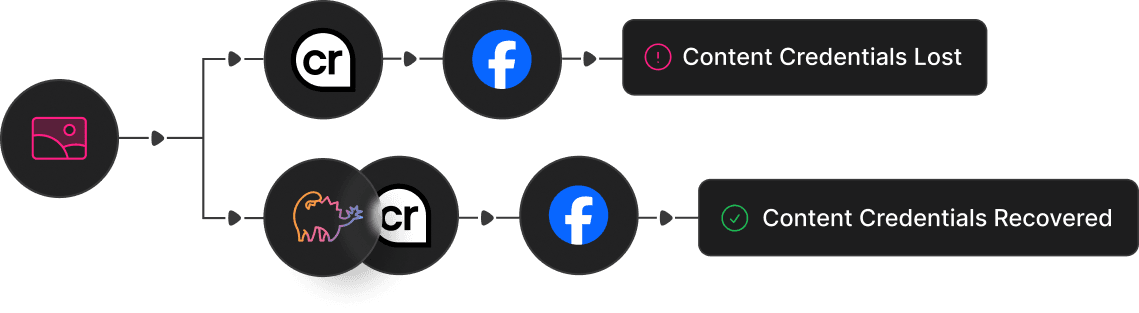
Media Authenticity for Maintaining Brand Trust
Media authenticity is now essential for organizations that rely on public trust. Images, video, and audio are often the primary way organizations communicate and establish credibility. At the same time, generative AI and advanced editing tools have made manipulated media easier to create and distribute. As skepticism rises, organizations must be able to prove that the content they publish is genuine to avoid reputational, operational, and legal risk.
Authenticity is no longer a technical detail. It is a strategic requirement that must persist as media moves through workflows, partners, and platforms. Verification must hold up after editing, resizing, compression, and reposting. Organizations across industries need durable authenticity signals that remain intact throughout the content lifecycle.
Content Provenance and the Role of C2PA
Content provenance provides transparency about where media originated, who created it, and how it has been handled. While it does not determine truth, it enables informed evaluation. As scrutiny of digital media increases, provenance is becoming a standard expectation for responsible publication.
C2PA establishes a shared framework for attaching provenance data to media, including capture details and AI disclosures. Adoption is growing, but metadata alone can be lost during editing or platform uploads. To ensure long term verifiability, provenance must persist beyond metadata and remain detectable in real world conditions.
How Organizations Use Steg.AI for Content Provenance
Steg.AI strengthens content provenance by embedding invisible, durable watermarks directly into media. These signals remain associated with images, video, audio, and documents even after editing or redistribution, without affecting quality.
Used alongside C2PA, Steg.AI reinforces provenance across the content lifecycle. While C2PA provides structured metadata, Steg.AI ensures authenticity signals persist when metadata does not. Together, they create a resilient, standards aligned approach to verifying media wherever it appears.
FAQs
Have a different question and can't find the answer you're looking for? Reach out to us and we'll get back to you as soon as we can.
Contact Us