
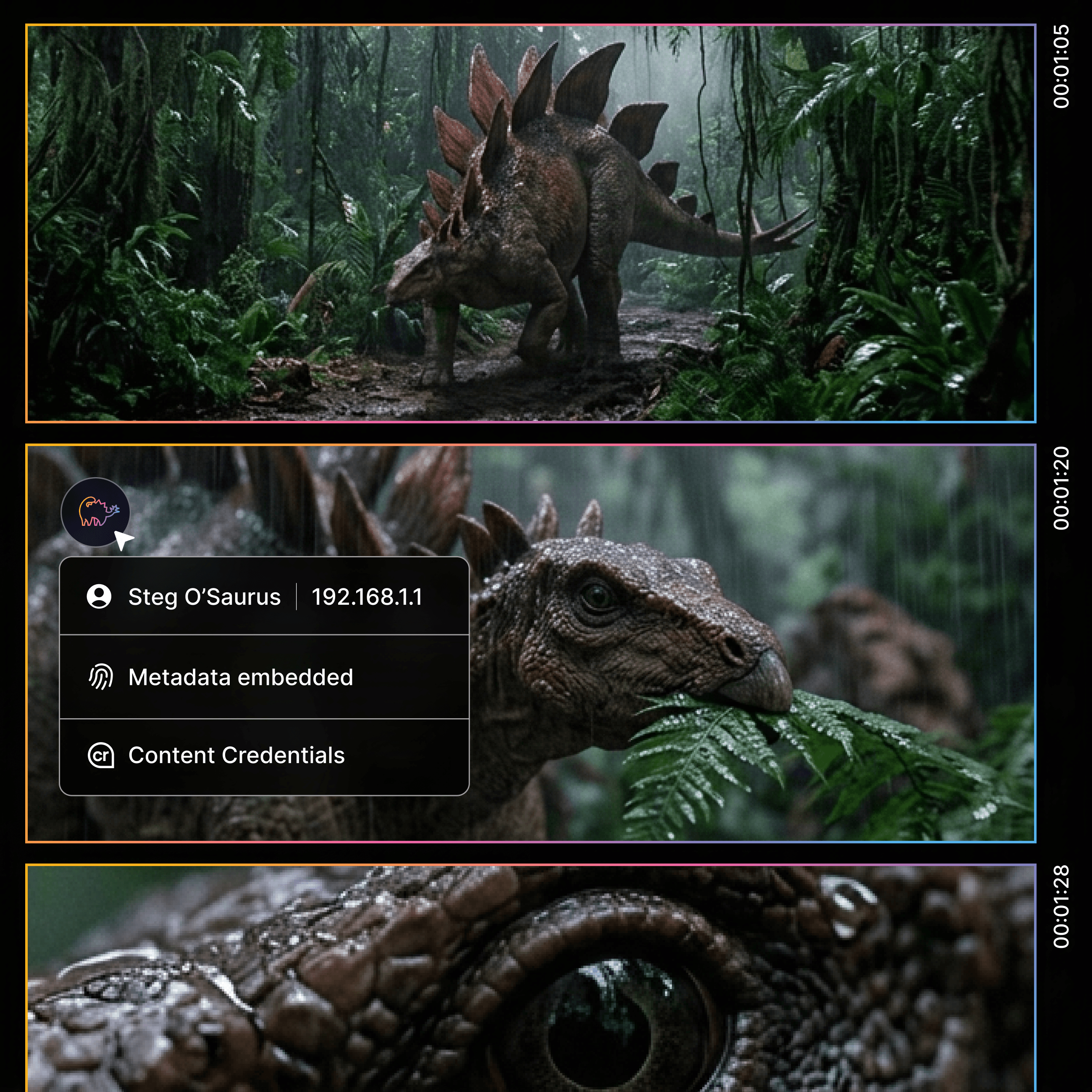
When the whole world wants to see your movie, it’s hard to keep the details in check.
Even Disney, which is as good as anyone in the industry at protecting its unreleased footage, still deals with the fallout from occasional leaks.
Take the hotly anticipated Avengers: Doomsday. Full trailers or long videos are still on lockdown, and the studio has kept a tight grip on the film’s biggest reveals. And yet recent screenshots, allegedly from the first scene of the upcoming movie, may have spoiled surprise character reveals fans expected to first see in theaters. Another leak claims to show what Robert Downey, Jr. looks like under his new Doctor Doom mask, with images good enough to make fans and journalists spend days arguing over whether they’re real.
So how does an image like this end up floating around the internet, when a studio with some of the best content-security resources in the industry is squarely pitted against it? And is there anything a studio can actually do to close the gap even further?
The short answer is that leaks like these follow a predictable pipeline: one that starts long before a single frame reaches social media, and one that most current protections were never built to catch.
Step 1: Point of access
Almost every leak starts with legitimate access. There’s no Tom Cruise-style thief rappelling down to nab screeners, dailies, and behind-the-scenes footage from a vault. Instead, video is distributed by design to editors, VFX vendors, marketing partners, awards voters, and dozens of other people who need to see a film before the public does.
That’s the fundamental tension of pre-release content: you have to let a lot of people in to get it made and marketed at all. And anything accessible in a watchable form by so many people can be captured by at least one of them.
The access point varies: hard drives, “secure” screener portals, shared review folders. But once the content reaches a human being’s screen, the studio has lost direct control over it. As MovieLabs, the technical body through which the major studios coordinate content-security standards, puts it, this kind of leak is uniquely hard to stop precisely because it only takes one compromised viewing session to put a copy into circulation.
Step 2: Capture
Yes, there are still people out there filming the screen. That might be how the unfinished Beyond the Spider-Verse trailer leaked following a showing at CinemaCon. However, it’s far more common for someone to simply take a screen recording or even a photo of a monitor, and get an image good enough that even seasoned entertainment journalists can’t help but cover the leak, even if they add caveats like “possible” or “alleged” in the headline.
That’s exactly why visible deterrents like burned-in timestamps or on-screen logos have stopped working. They irritate the legitimate viewer far more than they stop the determined leaker; really, they only ever catch the rank amateur.
Step 3: The first frame gets out
Here’s where we come back to the Doomsday leaks. Nobody uploaded a workprint of the film. All we see is a few screenshots pulled from a much larger body of footage, with nothing around it to explain where it came from.
Most detection systems are structurally blind to this method of leaking. If a watermark isn’t in that specific frame of a longer video, that frame says nothing about where it came from. That’s part of why leaks from a single still can circulate without anyone, including the studio, being able to say for certain where they originated.
The same gap shows up, at a slightly larger scale, with short video clips. A lot of leaks today never take the form of a full-length file at all. They’re 30-second-to-2-minute clips posted to social platforms, screen-recorded straight off a monitor and clipped down to a “look what I’ve got” moment before the full copy even circulates. That runtime can be too short to contain a full cycle that’s embedded once per scene or spread across a longer interval: the clip can end before the pattern ever completes.
Film leak prevention on a per-frame basis
This is the gap that a per-frame watermark will close. When every individual frame carries its own embedded, traceable payload, there’s no “unlucky” frame that happens to fall between watermark intervals. A single screenshot or a 15-second video clip becomes independently attributable to the exact copy, recipient, or distribution batch it came from. The forensic trail doesn’t depend on how much footage the leaker exposes. One frame is enough.
It’s the goal many forensic watermarking tools are driving towards, though no one has cracked the code to manage this type of leak attribution at scale yet.
Step 4: Fragmentation and scale
Once a screenshot or short clip drops, it’s off to the races. It gets reposted. Screenshots get taken of existing screenshots. Images get cropped to different aspect ratios or changed through generative AI. Then these copies get disseminated across Discord servers, X threads, and fan forums where they may be further degraded or altered.
There’s rarely a single pipeline you can shut down, at least not like there would be with a full-file torrent leak. Instead, there are thousands of individual reposts happening in parallel, which makes takedowns always feel like they’re a step behind the action.
At the same time, leakers are actively working to defeat any protections content might carry. Academic research out of the University of Maryland, covered by WIRED, found that common image watermarking schemes (not to be confused with forensic watermarking) could be reliably “washed out” using automated tools, and, in a twist that matters just as much, that fake watermarks could be added to unmarked images to trigger false positives.
It also cuts the other way: genuinely AI-generated fakes now circulate right alongside real leaks, and audiences increasingly can’t tell them apart on sight, which means a real leak can get dismissed as “probably AI” and buy itself extra time before studios can act on it. That was the exact situation when images from the 2025 Minecraft movie leaked. It wasn’t until the studio started tossing out takedown requests that fans had clear evidence that the leak was genuine. By the time that confirmation arrived, the images had already had their run.
When a trailer leaks in realtime
Screenshots aren’t the only shape this problem takes. When a low-quality version of the Spider-Man: Brand New Day trailer leaked online, accounts sharing it were hit with DMCA notices from Sony almost immediately, but only after the clip had already spread widely enough that takedowns were treating the symptom, not the source.
Why legacy watermarking fails at film leak prevention
Messy, modern leaks require a different kind of solution. A mark designed for a clean, unmodified file often doesn’t survive a screenshot of a screenshot, a run through an AI upscaler, and three rounds of social-media recompression. If the watermark can’t be read after the image has been through that wringer, it was never really evidence, just a label the leaker peeled off on the way out the door.
A watermark worth deploying has to be built for rough treatment so that whatever emerges on the other end of Step 4 is still traceable back to Step 1. This isn’t a fringe requirement. MovieLabs’ Enhanced Content Protection specification, the baseline studios use to license premium content, explicitly requires that forensic watermarks survive corruption, collusion attacks, and any transformation or capture technique that leaves the content still watchable.
Why frame-level and transformation-resistant go hand-in-hand
Any credible approach to film leak prevention has to reckon with both halves of this problem at once:
- Frame-level granularity without robustness catches leakers only if they distribute images or clips that survive untouched. That’s rare, since a quick AI upscale or a screenshot-of-a-screenshot is the first step of any serious repost.
- Robustness without frame-level granularity catches leakers only if they distribute enough contiguous footage to contain a mark. That’s useless against the screenshot, the freeze-frame, or the still that starts every leak before more footage ever appears.
Together, they close both gaps at once. Every frame is watermarked, and every watermark survives what happens to it next. That combination makes accountability a lot simpler.
The Trail Doesn’t Break Where the Trust Does
The anatomy of a leak is really the anatomy of trust breaking down somewhere in a long chain of legitimate access. That chain has to exist if the basic work of making a movie is to go forward. But that doesn’t mean traceability dies with that loss of trust. Ultimately, the practical core of film leak prevention is not making leaks impossible, but making every copy accountable.
When traceability lives in every frame and survives every transformation a pirate throws at it, the single frame that starts a leak becomes the single frame that ends it.